Diwali Brings the Community Together in a Vibrant Celebration of Culture, Gratitude, and Shared Humanity
By Angelique Redwood
There’s always electricity in the air when September rolls around in Centre County. Penn State’s campus fills, and people from across the globe unite to yell football cheers under stadium lights.
But the excitement continues off the field as the town gears up to celebrate the holidays and traditions shared throughout its diverse community.
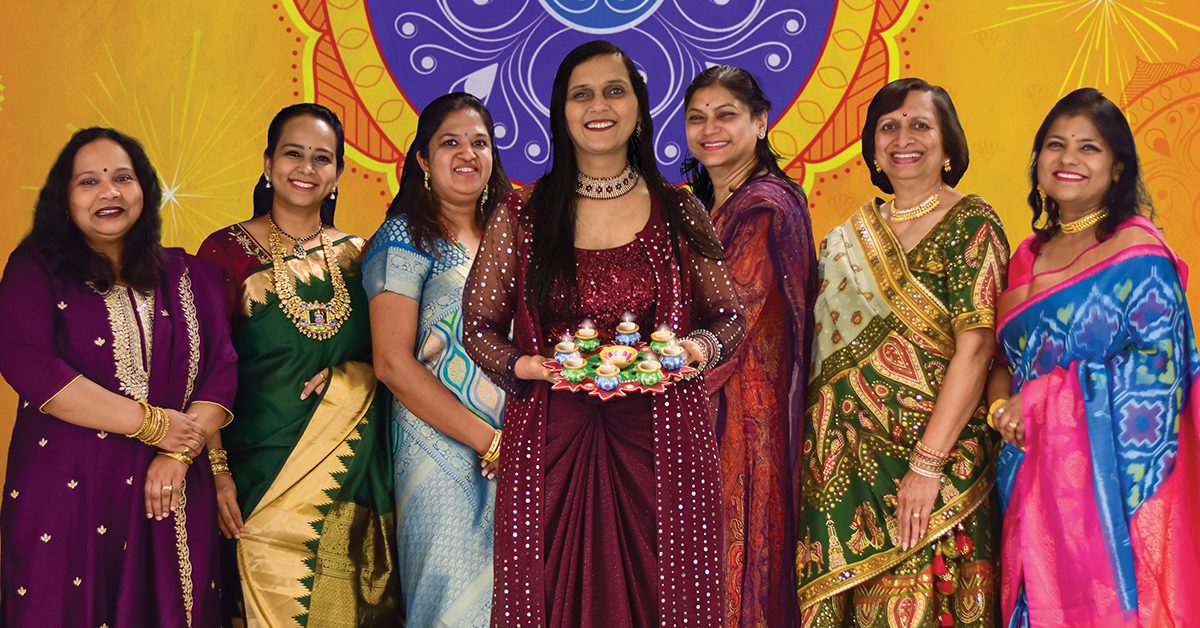
The Festival of Lights, better known as Diwali, may not usher in football cheers, but it still brings people from across the globe together to celebrate life, love, and family with music, dance, and incredible food to top it all off. For five fall days each year, the South Asian community celebrates good’s triumph over evil, lighting up the night during the darkness of the new moon in shared joy and company.
In 2026, Diwali takes place from Friday, Nov. 6, to Tuesday, Nov. 10.
Good over evil, light over darkness, and knowledge over ignorance are its primary themes, bringing families together to indulge in life’s blessings.
Diwali’s Five Days of Celebration
On day one, mini oil lamps known as diyas are sprinkled throughout the home alongside the creative art of rangoli, where flowers, spice powders, rice, and sand are used to display unique colors and designs that welcome good tidings into the home.
Beautiful rangoli designs continue to ward off evil and negativity from the dwelling into day two, while day three of Diwali is dedicated to celebrating good prospering over evil.
It’s this day that culminates in community celebration, bringing families to feast while exchanging sweets, songs, and prayers to honor the deities.
Day four ushers in gratitude for this life on Earth, and Diwali rounds out day five in celebration of our siblings and cousins, giving families another reason to share more time, food, and joy.
Altruism and gratitude remain the celebration’s central themes.
Recognized as an official holiday by State College Mayor Ezra Nanes in 2022 and made an official holiday by Gov. Josh Shapiro in 2024, Diwali is celebrated far and wide by the Indian diaspora.
In Centre County, the Happy Valley Indian Community brings residents together to share in the celebration. Whether Hindu, Buddhist, Sikh, or Jain, families spend a week enjoying the light each other brings to their lives, and State College gets to revel in these shared, joyous moments thanks to the South Asian communities that call Centre County home.
On the University Park campus, student organizations such as the South Asian Student Association (SASA) and the South Indian Association (SIA) came together last October to host a Diwali celebration in the HUB-Robeson Center, inviting students to blend their Penn State pride with their culture while enjoying food, raffles, and a live concert by artist Jay Sean.
State College’s famous India Pavilion lit up East Calder Way that same month by serving a lavish dinner buffet for the community, inviting everyone to walk in and enjoy the spirit of Diwali with friends, family, and a restaurant staple that’s fed the county since 1997.
Speaking with community member and project manager Laxmi Lauzon, I got a peek into the ways Diwali manifests in the county.
Celebration Is Community
After moving to State College a few years ago, the town’s diversity immediately provided Lauzon and her family ample opportunities to celebrate, and Diwali is one of the most vibrant ways she’s connected with the community.
“This is not a small celebration for the number of people that live here,” Lauzon says as she describes the handful of houses that open their doors in potluck style, sharing sweets and donning their best outfits alongside neighbors.
But for Lauzon, the core themes of Diwali permeate her life in more ways than one, and there’s no better way to highlight community and unity for her than coming together for a big celebration.
“I feel like the exchange that happens in a celebration, be it Rhoneymeade Festival, football going on, or Diwali, [is that] these places are charged with so much energy that the hate, differences, and division our brain creates every day dissolves,” Lauzon says.
This beautiful, celebratory blend is exactly what brought Lauzon to the U.S. in 2011.
“America lured me because it was access to so much diversity. That’s what I understand of America, that I can learn from so many people and I can have access to so many different types of experiences.”
Lauzon’s family embodies that diversity by regularly finding more than one reason to celebrate throughout the year.
“In my house, it’s a very diverse place, so we celebrate everything,” Lauzon says. “We celebrate Easter. We celebrate Holi. We celebrate Diwali. We celebrate Christmas. We celebrate everything there is, or what we know of.”
Even recently, Lauzon’s list of family celebrations continues to grow. When her daughter developed an interest in Hanukkah last year, it led to another opportunity for Lauzon’s family to celebrate alongside the Centre County community.
“We went to a family to learn about Hanukkah,” Lauzon says. “They celebrated, made latkes, and lit menorah candles with us.”
The most exciting part was how rewarding it was for her children to learn more about all parts of the globe, allowing Diwali’s themes of knowledge over ignorance to carry forward, even after the Diwali celebrations end.
“This is a whole global experience for our kids, which means a lot to them and their future,” Lauzon says, stressing the importance of celebration for generations past and present.
From the first seventh-century inklings of Diwali scratched in Sanskrit text, the importance of the holiday has always been its spiritual and ancestral connection — two ways human beings have learned to build lasting communities.
The intersection of culture grows these connections for everyone who’s in community with one another.
“That’s why I think raising my daughter here makes me feel good, because she can get in touch with people and she doesn’t have to feel a difference about their background. … It’s something to be grateful about.”
State College’s embrace of diversity is exactly what makes Lauzon proud to be a resident of Centre County.
Sharing Diwali’s Delights
Diwali celebrations become some of the greatest lessons on the prevailing good of humanity, regardless of the darkness that sometimes surrounds us.
“You want to do good when you’re in good company, so I think that’s what the success of a community is, where we share, we care, and we’re kind to each other,” Lauzon says. “For the community members, it will be passed down to the kids to make it a point to be in celebration, because we can forget our celebrations.”
With open arms, the State College community invites one and all to share in the joy, happiness, and communal abundance that Diwali brings.
For Lauzon, a person “who likes to explore life to its full capacity,” Diwali is an excellent opportunity to gather, learn about new cultures, and, most importantly, have a good time. “Many people come for food, for people, for performances, and many people just come because they want to be a part of it.”
“Many performers come from different places, so people who like Indian food, who want to explore a different culture, or enjoy folk dance and singing, this celebration has all of that.”
Even if you don’t observe Diwali or pray to the Hindu goddess Lakshmi for abundance or the Hindu god Ganesha for wisdom, you’ll still get to celebrate the joys of joining together with family, friends, and neighbors.
In the next two months, as leaves continue to fall and State College ushers in the cool air, keep an eye out for university and community members getting ready to bring the light, laughter, and generosity of this year’s Diwali to Centre County.
“In the South Asian community, we’re not doing anything new but trying to say that if State College is going to be a place to be, we will make it a place to be community,” Lauzon explains.“I feel like the nature of State College [and] this area is that you are going to love the people no matter who they are just by being there. … You will not be scared of somebody who comes to work with you and looks different because you’ve seen their festivals, you’ve had their food, and you’ve communicated with them. … You will be able to experience a world without going out of this country, experience a different kind of world right here.”
As religions across the South Asian diaspora prepare for their fall festivals, State College’s buzzing autumn excitement only grows louder.
In a season of harvest and giving, Centre County reminds us that nothing makes us more human than our shared cultures, especially when the generous celebration of Diwali comes around to light up the town.
That spirit of generosity extends beyond Diwali. The Happy Valley Indian Community, now a registered nonprofit, supports three local organizations during summer’s Centre Gives campaign: the State College Food Bank, Out of the Cold, and Centre County Meals on Wheels.
“Many people come together to perform and be a part of that celebration in spite of whatever their background is,” Lauzon says. “It’s a celebration of humanity. It’s a celebration of unity. It’s a celebration of good over evil. That is what Diwali really symbolizes.” T&G
Angelique Redwood is a freelance writer based in State College.